Tuesday, May 11, 2021

Kubernetes Versus Docker — DevOps Using Kubernetes & Docker

Credits: https://www.optisolbusiness.com/insight/kubernetes-versus-docker

 Kubernetes versus Docker — A topic that has been discussed numerous times in the cloud industry. Irrespective of your technical or non-technical background, this article will help you understand the key differences and help you with your business decision if you were to make one.

To put things in perspective, “Kubernetes or Docker?” — it is like comparing apples to oranges. Both can function without each other, however, can benefit greatly from each other.

Both Kubernetes and Docker are essential tools for a developer. We can also build DevOps Using Jenkins, Docker, and Kubernetes. Both Kubernetes and Docker help developers package applications into containers to run them in different environments.

Kubernetes is an open-source container-orchestration system for automating computer application deployment, scaling, and management.

It aims to provide a “platform for automating deployment, scaling, and operations of application containers across clusters of hosts”.

It works with a range of container tools and runs containers in a cluster, often with images built using Docker. Kubernetes originally interfaced with the Docker runtime through a “Dockershim”.

Many cloud services offer a Kubernetes-based platform or infrastructure as a service (PaaS or IaaS) on which Kubernetes can be deployed as a platform-providing service.

Docker is a set of platforms as a service (PaaS) product that use OS-level virtualization to deliver software in packages called containers.

Containers are isolated from one another and bundle their own software, libraries, and configuration files; they can communicate with each other through well-defined channels.

Docker can package an application and its dependencies in a virtual container that can run on any Linux, Windows, or macOS computer.

This enables the application to run in a variety of locations, such as on-premises, in a public cloud, and/or in a private cloud.

Docker implements a high-level API to provide lightweight containers that run processes in isolation.

According to Grand View Research, the global application container market size was valued at USD 1.5 billion in 2018 and is expected to register a CAGR of 26.5% from 2019 to 2025.

Thursday, May 6, 2021

BEST MACHINE LEARNING MODEL DEPLOYMENT IN AWS

 Credits : https://www.optisolbusiness.com/insight/on-demand-machine-learning-model-deployment-in-aws

An ergonomic assessment also called an ergonomic risk assessment, is an objective measure of the risk factors in your work environment that may lead to musculoskeletal disorders or injuries among your workforce, so that you can make measurable improvements in the work environment. This article describes how to use AWS Fargate serverless deployment platform to host and execute a Machine Learning computer vision model based on Google’s Media Pipe platform. The objective is to calculate human body angles from the pose points and assess their posture ergonomically to see if there is any strain on the body. We have used industry-standard RULA (Rapid Upper Limb Assessment) assessment sheet to generate the risk score for the user’s posture.

AWS FARGATE

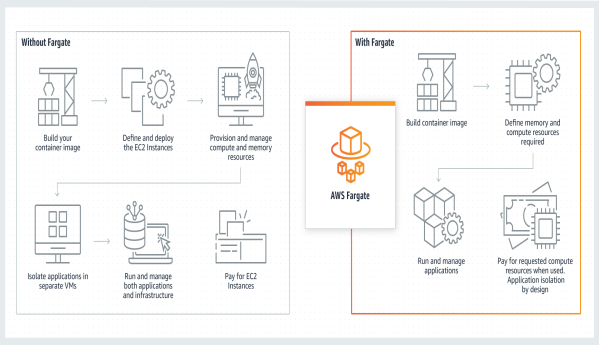
  • AWS Fargate is a serverless compute engine for containers that work with both Amazon Elastic Container Service (ECS) and Amazon Elastic Kubernetes Service (EKS).

MEDIAPIPE POSE

Media Pipe Pose is a Machine Learning model for high-fidelity body pose tracking. It infers 33 two-dimensional landmarks on the whole body (or 25 upper-body landmarks) from RGB video frames utilizing BlazePose research.

OBJECTIVE

  • The objective of the Media Pipe pose estimation project is to detect the pose points of a given image and to calculate the heights of the elbow, knee, hip, etc.

RULA (Rapid Upper Limb Assessment)

RULA was developed to evaluate the exposure of individual workers to ergonomic risk factors associated with upper extremity MSD. The RULA ergonomic assessment tool considers biomechanical and postural load requirements of job tasks/demands on the neck, trunk, and upper extremities. A single-page worksheet is used to evaluate required body posture, force, and repetition. Based on the evaluations, scores are entered for each body region in section A for the arm and wrist, and section B for the neck and trunk. After the data for each region is collected and scored, tables on the form are then used to compile the risk factor variables, generating a single score that represents the level of MSD risk.

The following are the steps for RULA Assessment

Step 1: Locate Upper Arm Position

Step 2: Locate Lower Arm Position

Step 3: Locate Wrist Position

Step 4: Locate Wrist Twist

Step 5: Look up Posture Score in TABLE A

Step 6: Add Muscle Use Score

Step 7: Add Force/Load Score

Step 8: Find Row in Table C

Step 9: Locate Neck Position

Step 10: Locate Trunk Position

Step 11: Locate Legs

Step 12: Look up Posture Score in TABLE B

Step 13: Add Muscle Use Score

Step 14: Add Force/Load Score

Step 15: Find Columns in Table C

OVERVIEW OF PROJECT

ANGLE MEASUREMENT

  • The pose points are fetched and stored in a list according to the profile (full front, right, left)

CONCLUSION

Thus, this article demonstrates the Efficient, on-demand, scalable, and cost-effective method of deploying the Google MediaPipe model in AWS Fargate’s serverless cloud.